CPE 103
Work with your assigned partner to complete the activity below.
Before you write any code, read the directions and write a
test
plan (what automated and manual tests you will create). Draw the
tree you will create, the data to be input (in
order), and show the exact program output you expect.
Implement the test plan you wrote as a test driver
to demonstrate that
all six methods perform
correctly. You may write a local main, but a JUnit
test is recommended. Compile your test driver and run
it. It should compile without error, and when executed it
should report that the tests fail.
We will be enhancing Weiss's BinarySearchTree implementation.
Download:
In the class header comment for BinarySearchTree include separate
@author tags for each student.
Implement the following six methods in your class. The
search()
and
traverse() methods must be implemented recursively.
search() must not call
find().
/** See if the tree contains a given item.
* @param target the item to search for
* @return true if the item is in the tree
*/
public boolean contains(AnyType target)
/** Recursively search the tree for the
target */
private boolean search(BinaryNode<AnyType>
curr,
AnyType target)
/** Show an ordered list of the items in the
tree,
* one item per line. */
public void list()
/** Recursive in-order traversal of the tree,
printing
each node */
private void
traverseInOrder(BinaryNode<AnyType> curr)
/** Print a formatted display of the tree.
*/
public void print()
/** Recursive pre-order traversal of the tree,
printing
each node
* indented an amount corresponding to its
level in
the tree.
*/
private void
traversePreOrder(BinaryNode<AnyType>
curr, int indent)
The formatted display uses indenting to show nodes on the
same
level at a consistent level of indentation, and periods where no child exists.
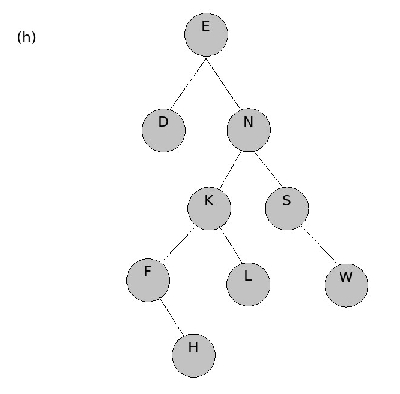
For example, the tree in
this diagram would print like this:
   E
      D
         .
         .
      N
         K
            F
               .
               H
                  .
                  .
            L
               .
               .
         S
            .
            W
               .
               .